
Smart RFx Management: Diverse Data, Lower Risk
Diverse supplier data and risk scoring shorten RFx cycles by widening the qualified bidder pool before the bid opens.

Founder & Chief Executive Officer
- Published

Every RFx cycle within the sourcing exercise represents a risk decision; it could be an RFP (request for proposal), RFQ (request for quotation), or RFI (Request for information). Thus, even experienced procurement teams find themselves in a dilemma while crafting RFPs.
A well-crafted RFP and RFI are mandatory for selecting the right vendors and suppliers. Yet, RFPs struggle to attract the right suppliers, often mismatching proposals or selecting vendors that don’t wholly align with your project needs.
RFPs can be transparent and consistent only when they are structured well; that means overly rigid evaluation criteria, or poor market engagement, will leave your business with subpar options.
Inevitably, by introducing an enriched inclusive supplier database, intelligent automation and risk management best practices into sourcing processes, you can reduce risk from day one of the third-party lifecycle.
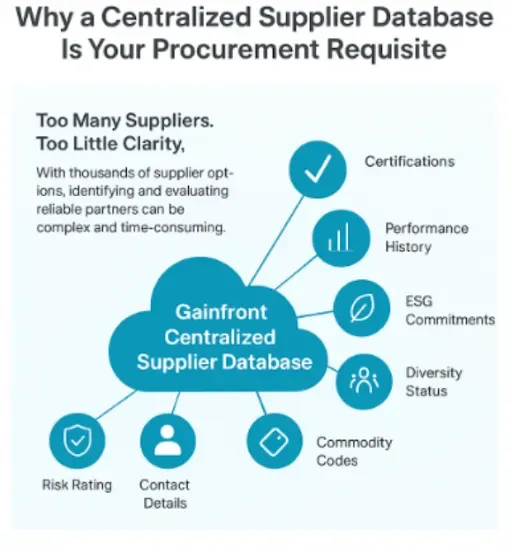
Why a Centralized Supplier Database is Your Procurement Requisite
Only the right suppliers are reliable. Such suppliers deliver quality and promote value to your organization. But with so many options out there, the question is: how do you identify and evaluate the best partners?
Here’s where a centralized supplier database becomes indispensable.
A centralized platform that stores key information about both current and potential suppliers is called a cloud-based supplier database. It stores contact details, commodity codes, certifications, performance history, diversity status, and ESG commitments. A centralized database also means access to extensive suppliers who are verified, including those demonstrating sustainability progress or holding recognized diversity certifications.
To emphasize this, it replaces obsolete, labor-intensive methods like spreadsheets and scattered file storage, making it faster and more convenient for businesses.
Benefits at a glance:
-
You can save hours of manual research through quick filters and search criteria like location, certifications, category, or diversity classification.
-
You can access thousands of suppliers, including diverse and underrepresented vendors, increasing competition, and driving better pricing.
-
It is easier for suppliers to view opportunities and submit bids online, allowing them to engage in the activity.
-
A broad supplier base always brings new perspectives, promoting diversity and inclusion for better procurement outcomes.
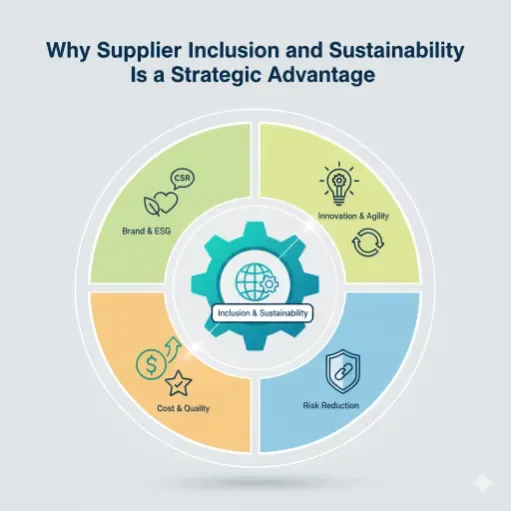
Why Supplier Inclusion and Sustainability Is a Strategic Advantage
After all, Supplier Inclusion is all about accessibility: for all.
It is important to realize, by attracting a wide range of suppliers from different backgrounds, companies open to unique ideas, creative problem-solving, and alternative perspectives that nurture innovation. It makes businesses agile, making them adaptable to market changes or disruptions.
Organizations reduce supply chain risks by relying on a broad supplier base that spreads dependency across a larger pool of vendors sprawled across industries and regions. This functionality maintains continuity during crises, natural disasters, or economic fluctuations.
Moreover, Supplier Inclusion always encourages healthy competition because it taps into niche and underserved markets. This results in cost savings and better quality.
To meet inclusion targets, many businesses partner with suppliers showcasing strong ESG and sustainability performance. Now, procurement teams can easily identify suppliers with sustainability commitments that align with corporate ESG objectives.
Consequently, by contributing to CSR (Corporate Social Responsibility), businesses signal their obligations to stakeholders and strengthen their brand reputation.
The Role of Intelligence and Automation
As can be seen, RFx Management is drudgery when done manually. Intelligence and automation are the right approach to RFx Management as it brings structure and speed to what was once open to error.
Intelligence, on the one hand, contributes to strategizing and decision-making. It does so by analyzing historical data, market trends, and supplier performance to improve supplier matching and sourcing outcomes. Intelligence reveals qualified suppliers, evaluates proposals using AI, predicts risks, and supports negotiation strategies with data-backed insights.
Automation, on the other hand, focuses on handling repetitive tasks like document creation, response aggregation, and reporting. It standardizes, tracks progress, and integrates with ERP, contract, and supplier management systems.
EfficiencyAI™, Gainfront’s proprietary intelligence engine, is such an example of this advancement. It automates RFP drafting, extracts data from unstructured proposals, performs side-by-side comparisons, and continuously monitors supplier risk: empowering teams to act on insight, not instinct.
Given these points, the result is transformative: faster cycle times, superior supplier selection, and less exposure to operational or compliance risks.
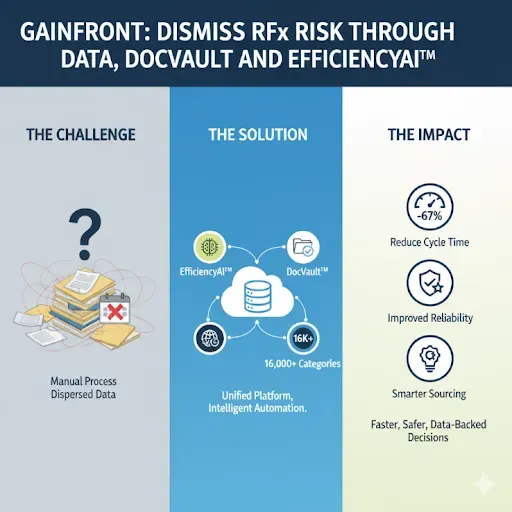
Gainfront: Dismiss RFx Risk Through Data, Docvault and EfficiencyAI™
Poorly run RFPs result in unproductive supplier choices. Gainfront removes that risk by pairingEfficiencyAI™ with a vetted supplier database spanning 16,000+ categories. Each supplier is enriched with performance metrics, risk indicators, and certification data, ensuring procurement teams can make fully informed, data-backed decisions.
DocVault™ complements this by providing verified, audit-ready supplier documentation and integrates it into the RFP process. As a result, procurement teams can easily import preexisting questionnaires: such as IT security, data privacy, or compliance templates directly from DocVault™ into new RFPs. This feature ensures that all supplier documents are current and accessible.
Gainfront’s automation capabilities reduce your RFP cycle time by up to 67%, providing measurable efficiency. Gainfront’s AI-driven templates, real-time scoring, and auto-extracted proposal insights, boost teams moving from weeks to hours: all while ensuring accuracy across every stage.
Challenge: Manual RFPs increase the risk of poor supplier selection.
Solution: Gainfront’s diverse, risk-scored supplier database and intelligent automation mitigate that risk.
Impact: RFP cycles reduced by 67%, supplier reliability improved, and sourcing made faster, safer, and smarter.
Validated Results, Real Impact
The performance gains with Gainfront’s RFx automation are tangible and data-driven:
-
95% reduction in RFP drafting time (as reported by a Procurement Director at a global manufacturing firm).
-
87% fasterRFP cycles through automated templates and scoring engines.
-
Seconds, not days, to generate compliant RFPs.
-
65% faster supplier evaluations with real-time scoring and AI-driven insights.
-
Teams scaling from3 to 15 RFPs per month, with higher accuracy and response rates.
-
EfficiencyAI™ users achievingup to 70% total cycle-time reduction across the sourcing lifecycle.
These figures represent a strategic reallocation of time, talent, and focus toward higher-value decision-making.
The Future of RFx Is Risk-Aware, Data-Driven, and Sustainable
An organization must perceive RFx as a competitive differentiator. The combination of supplier inclusivity with intelligent automation reduces susceptibility, gives a push to sourcing, and speeds up innovation throughout your value chain.
Gainfront is helping enterprises build risk-aware RFx processes that are efficient and built for a dynamic global market.
Therefore, the future of RFx is intelligent, inclusive, and risk-aware, offering advanced visibility into those meeting diversity and sustainability commitments.
Overall, EfficiencyAI™, DocVault™, and Gainfront’s verified supplier database offer you with the greatest sourcing advantage.
Comparison chart featuring Gainfront, Responsive.io (RFPIO), and Scout RFP:
| Feature | Gainfront (EfficiencyAI™) | Responsive.io (RFPIO) | Scout RFP |
|---|---|---|---|
| Key Feature | End-to-end RFx strategic sourcing platform | Proposal collaboration platform | Workflow automation tool |
| Core Focus | Complete RFx automation and supplier lifecycle intelligence with built-in diversity and ESG scoring | RFP creation and response automation | Simplified sourcing and approval routing |
| Supplier Database | 16,000+ categories with verified ESG, diversity, and risk metrics; proprietary AI-enriched database | No built-in supplier database; depends on external sources | Basic supplier listing and scoring |
| Risk Mitigation | Continuous risk monitoring, compliance validation, and predictive analytics | Limited features focus on response accuracy | Minimal features centered on process tracking |
| AI Engine | EfficiencyAI™ — generative AI for supplier discovery, contract analysis, and intelligent sourcing strategy | AI assistant for response recommendations | GenAI for instant response drafting |
| Cycle Time Reduction | Up to 67% faster RFx cycles and 95% faster drafting | 40–50% faster response times | Up to 55% faster approvals (limited to workflow) |