
How to Choose Supplier Management Software
Test supplier management software on one identity: inherent risk at onboarding, reliability view, and whether performance reads it. Checklist, not a ranking.

Founder & Chief Executive Officer
- Published
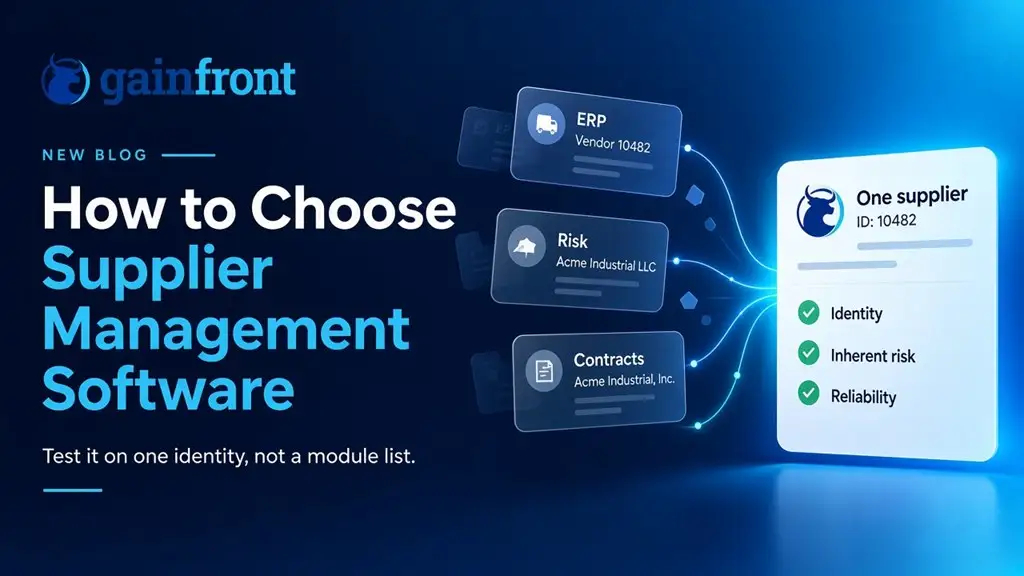
The shortlist on the table has six logos from a source-to-pay report and one more from a conference. Every demo opens with an agent. None of them has been asked to take vendor 10482, the ID accounts payable pays, the risk file’s “Acme Industrial LLC,” and the contract file’s “Acme Industrial, Inc.,” and show one supplier.
That is the buying decision. Supplier management software is the system that has to hold that supplier. Choose it by whether it scores inherent risk at onboarding, keeps a reliability view on that identity, and lets performance read the same record. Module count is a weak test. A purchasing suite with a risk tab is still a purchasing system. If that suite already has real adoption, orchestrate the record instead of replacing it.
What to test in the demo
Bring three rows of one supplier. Do not let the vendor pick the example.
| Row | Where it lives today | What it holds |
|---|---|---|
| Vendor 10482 | ERP vendor master | The ID accounts payable pays |
| Acme Industrial LLC | Risk file or questionnaire tool | A score, often from a survey run after go-live |
| Acme Industrial, Inc. | Contract or diversity file | An agreement, and a certificate of insurance that expired in March |
Ask for five things, in this order. Stop the demo when one of them fails. The rest of the slides will not repair it.
- Match them before anyone creates a vendor. The surviving identity should key off tax ID, legal name, and site, then point at 10482. Two rows that fail that match are not one supplier yet. A cleanup script that runs after go-live is a project, not a product.
- Score inherent risk on that identity before the first purchase order. Inherent risk is the exposure you accept by using this supplier for this purpose: category, geography, how hard they are to replace, and the evidence already owed. It is recorded at intake. A questionnaire three weeks after the vendor is live is a different process. Supplier risk management starts at onboarding if you want the operating definition.
- Show a reliability view that is quiet for a healthy supplier, and say what would move it. Most suppliers will never produce a bankruptcy headline. If the only signal on the screen is a news alert, the index will sit still for the suppliers you actually buy from. Ask which evidence changed the view: documents in force, delivery and quality once they exist, open findings. Weights are your operating model. A vendor that will not show the evidence behind the number is selling a label.
- Put last quarter’s receipts and the expired insurance on that same ID. No export, no second login. supplier performance scores on a fractured master are useless when they attach to a different spelling than the one accounts payable pays. An expired certificate that lives in a shared drive is not on the record.
- Name the system of record if the suite or the ERP stays. “We sync” is not an answer until you watch the sync miss “LLC” versus “Inc.” Invoice and purchase-order truth can stay in the system that already pays. Risk, reliability, performance, diversity, and CSR evidence all have to be readable from one identity.
| Test | Pass | Fail |
|---|---|---|
| Identity | One surviving ID, matched to 10482, no fourth vendor created | A new supplier record, with a promise to reconcile later |
| Inherent risk | Scored at intake, and the first PO waits on it | A risk tab the team fills in after the vendor is approved |
| Reliability | Evidence you can point at; useful when nothing dramatic has happened | A distress headline, or a score with no inputs |
| Performance and documents | Receipts and the expired COI sit on that ID | A dashboard fed by a monthly file |
| Stack you keep | A stated owner for the supplier identity, and a stated owner for the invoice | “All of them, they integrate” |
If the room answers these with a slide about agents, ask for the three rows again. In Deloitte’s 2025 Global Chief Procurement Officer Survey, data quality was the internal risk of generative AI that CPOs named most often (43.97%), ahead of governance, security, and compliance (35.41%). An agent pointed at three spellings will file a fourth.
Suite, specialist, or the ERP vendor file
Gartner’s Magic Quadrant for Source-to-Pay Suites, published 21 January 2026, evaluates an integrated suite: source, contract, request, procure, receive, and pay. Coupa, GEP, Ivalua, Oracle, SAP, and Zycus were positioned as Leaders. Zip, the only vendor added that year, and JAGGAER were positioned as Visionaries. That is a shortlist for a suite. It is not a score of whether risk sits on the vendor accounts payable pays.
The inclusion bar makes the gap concrete. A vendor has to offer sourcing, contract lifecycle management, supplier information and performance management, procure-to-pay, a supplier portal, and spend analytics, integrated with each other and able to post to an ERP. Supplier risk management is optional. It sits with category management and advanced sourcing optimization as a module a vendor may include. A Leader can be a complete purchasing system whose risk product you never turn on.
Gartner also estimates source-to-pay software spend at about $18.7 billion in 2029, from a 16.3% five-year growth rate. The money in the market is the suite. Your evaluation still has to separate four purchases that get bundled in the same RFP.
| Path | What it is built to do | Choose it when | A weak reason to buy it |
|---|---|---|---|
| Purchasing suite (Coupa, SAP Ariba, GEP, Ivalua, Oracle, JAGGAER, Zycus) | Source, contract, order, receive, pay, and a portal suppliers will actually open | Requesters already buy in a catalog and invoices match | “It has a supplier module,” counted as a line on a checklist |
| Intake orchestration (Zip and peers) | Route a request across the tools you already run | The front door is email, and the suite is staying | The hope that a faster intake form creates one supplier identity |
| ERP vendor master | The ID accounts payable pays, plus basic vendor maintenance | You need a payment identity | Certificates, scorecards, and diversity evidence, which it does not hold |
| Point tool (risk, diversity, or spend analytics) | One job, with an owner and a budget | That job is real and the suite will not cover it this year | A second master you will reconcile by spreadsheet |
| Supplier record | One identity that onboarding, risk, performance, and CSR write to | The suite or the ERP stays, and the record is the gap | A catalog and an invoice match. That is a suite job |
A single data model inside a suite is a real advantage for the process that suite runs. It does not merge the ERP vendor master, the risk file, and the diversity database you are keeping. Zip’s own 2026 position is the orchestration case: Gartner cited workflow integration and business-user administration as strengths, and noted thinner depth in parts of upstream sourcing and contracts. Use Zip, or anything in that lane, when the pain is the front door. Then still run the identity match.
Questions worth putting in the RFP
Paste these into the bid. A feature matrix of two hundred rows will not surface them, because every suite checks “supplier management.”
- Which key is the surviving supplier identity: tax ID, a DUNS number, the ERP vendor number, or your own? Show the match rule for “LLC” versus “Inc.”
- Can onboarding attach a new ship-to site to vendor 10482, or does it open 10483?
- Is the first purchase order blocked until inherent risk is scored on that identity? Who is allowed to override the block, and is the override stored on the record?
- What evidence moves the reliability view, and can a buyer see the reason without a services engagement? Confirm you are not being handed a financial-distress feed and a logo.
- Can delivery, quality, an insurance expiry, and a diversity certificate attach to that ID without a nightly file from IT?
- If we keep our current suite and our ERP, which system owns the supplier relationship, and which owns the invoice? Name the fields that are mastered in each.
- Is the agentic AI in the base subscription, or metered? Gartner’s January 2026 note on Coupa is the pattern to price in general: advanced AI on a token model, with usage still unclear for customers who have not run it for a year. Ask every finalist, including the ones who do not use tokens.
- Provide one reference whose path matches yours. A customer who replaced a suite is the wrong proof if you are keeping yours. A customer who “integrates with everything” is the wrong proof until they show one identity.
People will call the category supplier lifecycle management or supplier relationship management. The buy is still one record that starts with risk. SRM, in this evaluation, means that entry: inherent risk and a reliability view at onboarding, then performance and CSR on the same identity. Lifecycle is the wider set of modules: sourcing, contracts, and spend, writing back to that record. Neither acronym belongs in the title of the RFP. The tests above do.
When the suite is the right answer
Keep the suite when people use it. Requesters buy from the catalog. Invoices match the order. Suppliers complete portal tasks without an analyst chasing them. In that company, ripping out procure-to-pay to fix a supplier record is a transformation in search of a data problem.
The record can sit on top of a suite that already pays. Orchestration is the honest path: intake and supplier context across Coupa, Ariba, or the ERP, with the vendor ID you already pay as the key. Replace a module when that module is shelfware. Empty catalogs and buying-by-email are a suite problem. Five spellings of one supplier are a record problem. They often travel together. They are not the same project.
Deloitte’s same 2025 survey is useful here as a scope check, not as a software ranking. Of the more than 250 CPOs surveyed across 40 countries, 56.98% listed siloed ways of working among their top three barriers to delivering procurement value, and the report names cross-functional silos as the top barrier. The risk strategies they trust assume one supplier: 74% named active alternate sources, 64% named supply-chain visibility, and 61% named better supplier information sharing. An alternate source filed under a second legal name is not an alternate source. Visibility into the wrong ID is a confident mistake.
Skip a supplier-record project when the only pain is “we need a catalog and invoices that match.” That is the suite. Skip a new suite when the only pain is “risk, performance, and diversity cannot agree on the vendor accounts payable pays,” and the suite you have is the one people already use.
If you are unsure which pain you have, eight questions on the procurement stack scorecard separate “replace the stack” from “orchestrate what you own.” The score is on screen. It is a diagnostic, not a shortlist.
Gainfront is built for the five tests in the demo. The supplier lifecycle suite writes onboarding, inherent risk, and a reliability view to one supplier identity, and performance, diversity, and CSR evidence read that identity. When the purchasing system stays, AgentFlow orchestrates the tools you already run and keeps that supplier context at the decision. Bring vendor 10482 and the two other spellings to a 30-minute working session.
What “best supplier management software” lists are actually ranking
Search results for the best supplier management software rank vendors who already have analyst coverage, a supplier network, and a long module list. Those facts matter when you are buying a suite: network scale changes supplier adoption, and module depth matters for sourcing events and invoice match. They do not tell you whether inherent risk is on the identity you pay.
Use the January 2026 quadrant as the suite shortlist it is. Then run the five tests. A vendor absent from that quadrant can still be the system of record for the supplier, because the quadrant did not require risk, and it did not grade the join to the ERP vendor master you already have. A vendor inside it can still fail the demo on Tuesday.
FAQ
Is supplier management software the same as a source-to-pay suite?
No. A source-to-pay suite is an integrated system to source, contract, request, procure, receive, and pay. Supplier information and performance management is one required piece of that suite. Supplier risk management is optional in Gartner’s January 2026 inclusion rules. Supplier management software, for a team that already owns a suite or an ERP, is the record those transactions should read.
What is the difference between SLM and SRM when buying software?
SRM is the entry: inherent risk and a reliability view captured at onboarding, then performance and supplier-responsibility evidence on that identity. Supplier lifecycle management is the wider system: sourcing, contracts, spend, and more, all writing back to the same record. Buy the entry if the record is the gap. Buy the wider system if you also intend to move sourcing or contracts.
Should we replace Coupa or SAP Ariba?
Replace them when requesters do not use them. Keep them when catalogs, orders, and invoices already run there, and put the supplier record on the vendor ID accounts payable pays. Orchestration covers that path. A second full suite, bought to solve five spellings of one supplier, adds a sixth.
How do we test AI claims in the demo?
Point the agent at vendor 10482, Acme Industrial LLC, and Acme Industrial, Inc. Ask it to approve a new site. A pass is one identity, inherent risk scored before the PO, and the expired insurance visible on that record. A fail is a summary no one can trace, or a new vendor. Data quality was the top internal generative-AI risk in Deloitte’s 2025 CPO survey. The model does not repair a split master.
Can we evaluate software before the vendor master is clean?
Yes. Run the demo on one supplier whose three rows you can hold in your hand. Hold a program-wide scorecard until the match rule exists, the same way a performance score should be withheld when the IDs do not join. Software that requires a finished master before it can match a supplier is software you will wait on forever. Matching at onboarding is what stops the next duplicate.
Sources
- Gartner, “Magic Quadrant for Source-to-Pay Suites,” Micky Keck, Kaitlynn Sommers, Lynne Phelan, Magnus Bergfors, and Alex Brady, 21 January 2026, ID G00833291. Placements cited from that report: Leaders: Coupa, GEP, Ivalua, Oracle, SAP, Zycus; Visionaries: JAGGAER, Zip (the only vendor added). Supplier risk management is an optional standard module, not a required one. The $18.7 billion / 16.3% CAGR figure is Gartner’s source-to-pay forecast for 2029, as cited in that Magic Quadrant (Forecast: Enterprise Application Software, Worldwide, 2023–2029, 4Q25). Coupa’s advanced-AI token pricing is a caution in the same report. Gartner’s graphic and full text should be read in the report, not from this summary.
- Deloitte, “2025 Global Chief Procurement Officer Survey” (more than 250 CPOs, 40 countries). Figure 5: 56.98% listed siloed ways of working among their top three barriers. Figure 18: data quality 43.97% and governance, security, and compliance 35.41% as internal risks of implementing generative AI. Figure 31: 74% active alternate sources, 64% supply-chain visibility, 61% supplier information sharing.
- Vendor notes used only to confirm public placements: Coupa, SAP, GEP, Oracle, and Zycus each announced a Leader position in January 2026; Zip announced a Visionary position and that it was the only new entrant.